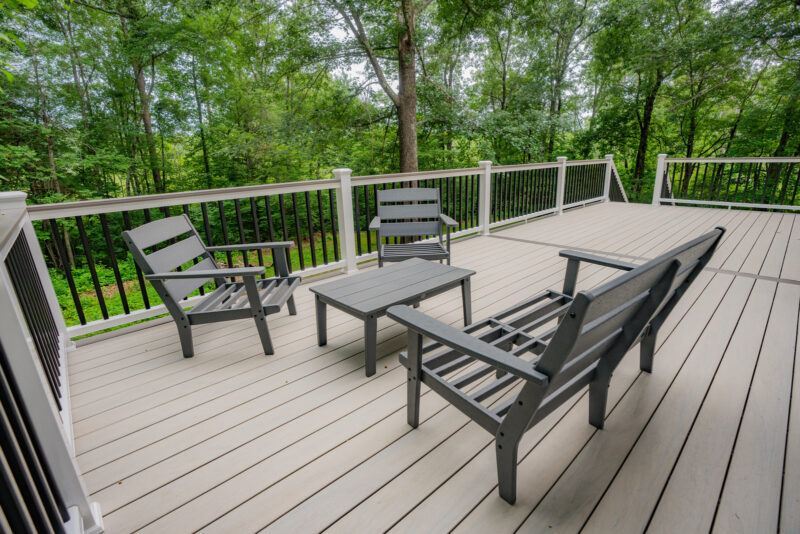
As homeowners and builders continue searching for more sustainable building materials, the future of composite decking is beginning to look far more environmentally friendly. Researchers are now developing innovative composite decking materials that may actually help remove carbon dioxide from the atmosphere.

Traditional construction materials contribute heavily to global carbon emissions. In fact, buildings and the materials used to construct them account for a significant percentage of worldwide greenhouse gas emissions. Composite decking has long been viewed as a more durable alternative to traditional wood decking, but new advancements are pushing the industry even further toward sustainability.
Scientists at Pacific Northwest National Laboratory recently developed a new type of composite decking that is considered “carbon negative.” This means the decking stores more carbon dioxide (CO2) than is released during its manufacturing process and lifespan. The material is made using recycled plastic, lignin from papermaking, and low-quality brown coal that would otherwise go unused or be burned.
What makes this technology unique is the way researchers chemically bonded captured CO2 directly into the materials used to create the decking boards. The result is a durable composite product that meets international building standards while actively storing carbon.

Beyond the environmental benefits, the decking also offers practical advantages for homeowners. The material performs similarly to standard composite decking products, with strong durability, resistance to weathering, and a natural wood-like appearance. Researchers also found the boards could be manufactured at a lower cost than traditional composite decking, making them both eco-friendly and economically appealing.
If this technology becomes widely adopted, the impact could be significant. Researchers estimate that replacing all composite decking sold annually in the United States with this carbon-negative alternative could help sequester hundreds of thousands of tons of CO2 every year.
The future of composite decking is clearly moving toward smarter, more sustainable materials that combine performance, longevity, and environmental responsibility. As innovation continues, homeowners may soon have access to decking products that not only improve their outdoor living spaces but also contribute to a cleaner future.